Navigating a high-altitude mountain pass in the French Alps or tracking wildlife through the cloud forests of Costa Rica yields an overwhelming amount of raw data: terrain elevations, route markings, weather windows, and ecosystems.
Capturing that complex environment and translating it into clear, accessible, and actionable digital experiences is where outdoor exploration intersects with expert digital communication, information architecture, and content strategy.
Building my platform, My Travel Mindset, from the ground up since 2023 served as my personal testing ground to evaluate, refine, and prove core digital skills within a realistic ecosystem.
Here is how the synthesis process—from field data to a structured digital asset—laid the foundation for a modern, AI-ready communication strategy.
Part 1: The Engineering Process of the Digital Experience
Raw information without a strategic hierarchy is merely noise. To prevent thousands of kilometers of global travel data from turning into an unstructured digital graveyard, I designed a modular and scalable content system around three communication pillars:
1. Advanced Information Architecture (IA) & Content Design
To streamline navigation through complex regional networks, I applied a strict content hierarchy:
- Silo Structure: Unstructured field notes grouped into three operational pillars (Roadtrips, Hiking Trails, Nature Outdoors).
- Topic Clustering: Strategic macro-guides (such as a 28-day South Africa itinerary) directly linked to micro-execution articles (such as specific hiking trails and park regulations).
- UI/UX Scaffolding: Consistent data structures, clear navigation paths, and visual anchors applied to minimize the reader’s cognitive load.
2. Editorial Discipline & Strategic Niche Positioning
One of the most challenging aspects of communication strategy is maintaining boundaries. Instead of diluting the brand by chasing generic travel trends (such as luxury resorts or nightlife), I maintained strict editorial discipline: the focus remained exclusively on self-drive logistics, mountain passes, and protected nature areas. Sharp focus builds brand authority and audience trust far more rapidly.
3. Data Integrity Meets Visual Storytelling
Impactful communication thrives at the intersection of narrative and data precision:
- Authentic Visuals: 100% original, copyright-tagged photography (©mytravelmindset) to protect brand identity and maintain visual consistency across international regions.
- Actionable Intelligence: Personal stories combined with hard operational specifications (transit routes, GPS starting points, elevation profiles, and park regulations) to convert passive readers into informed decision-makers.
Part 2: The Shift from SEO to GEO (Generative Engine Optimization)
What began as a thoughtful foundation for digital content design proved in hindsight to be the exact blueprint for the largest acceleration in search engine history: the transition from Search Engine Optimization (SEO) to Generative Engine Optimization (GEO).
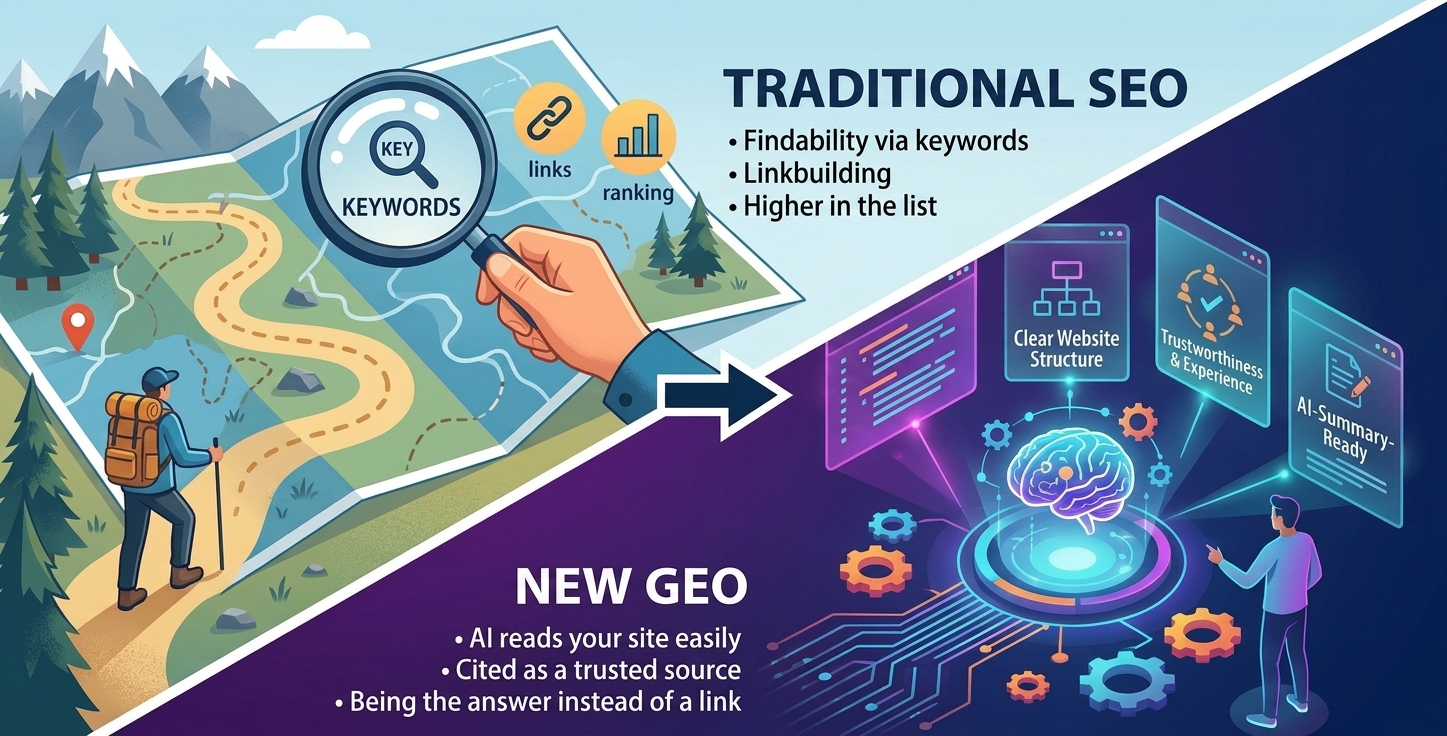
The digital search landscape has fundamentally changed. Online searches no longer revolve around matching keywords to rank on page one of Google; they are about being cited as a trusted source within AI-generated summaries from models like ChatGPT, Perplexity, and Google Gemini.
| Feature | Traditional SEO | Modern GEO |
| Focus | Keyword density + Backlinks | Information architecture + E-E-A-T |
| Outcome | Ranking in a list of links | Synthetic AI citation in answers |
Large Language Models (LLMs) do not simply collect links; they synthesize answers. Unstructured or generic content gets filtered out. Because My Travel Mindset is built on structured data and unique field observations, it became a textbook example for GEO:
- E-E-A-T as AI Fuel: AI models are flooded with generic web text but suffer from a shortage of verified human experience. Publishing exact GPS coordinates, current conditions, and original imagery meets the demands of Experience, Expertise, Authoritativeness, and Trustworthiness (E-E-A-T).
- Semantic Entity Mapping: LLMs process information through entities and their interrelationships. By directly linking macro-routes to micro-guides, AI crawlers can read the site as an interconnected knowledge graph rather than isolated articles.
- Summary-Ready Formatting: Structuring information with concise data points, clear headings, and tables enables AI engines to effortlessly extract facts directly into an AI Overview.
The Professional Conclusion
The transition from SEO to GEO proves that an effective digital strategy is not about “tricking an algorithm” with keywords—it is about structuring reality.
Running My Travel Mindset on a cost-effective infrastructure during this phase highlights the core of this case study: during the validation phase, content quality and information architecture triumph over expensive platforms. It proves that with minimal overhead and a sharp, constraint-driven strategy, you can build a fully realized, AI-ready authority.
Only when the platform is deployed commercially—such as through monetization, brand partnerships, or e-commerce—does transitioning to a custom top-level domain and bespoke infrastructure become the logical next step. This allows for optimal capitalization on brand equity, conversion, and advanced Schema Markup.
Whether mapping an alpine route through Parc des Écrins, designing a complex content architecture for a digital platform, or preparing a brand for the future of AI search engines, my core expertise remains the same: synthesizing complex, unstructured data into clear, user-centric, and strategically grounded digital experiences.
GEO is not a one-time checklist item, but a continuous process. After all, the rule for any future-proof site remains: a website is never finished and builds its authority through ongoing optimization.